


Enough time has passed, the dust has settled and I’ve just returned from a football trip to England that might still be talked about on this site for a while, so it finally feels like the right moment to summarize Hapoel Tel Aviv’s debut EuroLeague season. Incidentally, this is also my own debut in the not-so-simple business of writing and commentary around the 40-minute game played on the hardwood. The perspective I’m bringing will try to wrap all these firsts into a summary of a very long European season (42 games), while throwing out a few bold takes and predictions regarding the standouts, disappointments and breakout players of the year, as well as trying to understand what this Hapoel Tel Aviv side is still missing in order to take its “Galácticos” project one step further next season.
If we want, we can label Hapoel’s season however we like, success or failure because there are plenty of arguments in both directions, usually depending on the allegiance of the person making them: yellow or red and among the reds, pro-Ofer or anti-Yanai. Fortunately and unfortunately, I don’t really take sides in that debate, which gives me the freedom to use all the arguments and let you, the readers, judge for yourselves. Mom, look – your son is doing independent journalism.
Let’s start with the dry facts. Hapoel finished sixth in the EuroLeague with a 23–15 record, which secured two things that were critical for the continuation of the two-year “Red Galácticos” project: a four-game educational series against “Playoff Real Madrid,” and more importantly, a place in next season’s EuroLeague.
That season ended with a Game 4 loss in Bulgaria to Los Blancos. Thus concluded a campaign that was a roller coaster by every possible standard. A professional roller coaster between stretches of dominance near the top of the standings and difficult slumps that led, among other things, to panic signings, some more justified than others. It was also a logistical and financial roller coaster that began in exile in Sofia, returned home to Israel for three short months, and then headed back to Bulgaria due to the war with Iran, which caused postponements and even split the team apart. It was an emotional and media roller coaster as well, amid ownership changes, the ongoing arena saga and the continuing fracture with the fanbase supporters who wanted to get excited about their team but struggled to identify with it. Sometimes they didn’t even want to buy a ticket.
Despite all the difficulties, the Reds survived the season and finished standing upright. Hapoel never dropped out of the EuroLeague’s top six all year, placed a player on the All-EuroLeague First Team, and recorded prestigious wins over Panathinaikos, Fenerbahçe and others of that caliber. The fact that they managed to overcome all the challenges created by the Middle Eastern security situation, while simultaneously dealing with a complete lack of experience in such an intense format against 17 entirely unfamiliar opponents (except for Maccabi and Valencia), and still achieve the ambitious goal of reaching the playoffs in their debut season, that deserves a bravo.
To understand just how successful Hapoel’s season really was, you can simply look across the city at the yellow-and-blue side. The veteran powerhouse suffered from the exact same logistical, financial and media-related difficulties. Oded Katash’s roster was obviously less talented than the one at Dimitrios Itoudis’ disposal, but the contrast in the nature of their seasons stood out far beyond any professional gap in quality. Maccabi Tel Aviv’s Play-In dream hung by a thread from the end of November until it finally died in a manner that, in hindsight, surprised very few people. On the other hand, if at the start of the season I had told the average Hapoel fan that he would end up disappointed after finishing only sixth, above Red Star, Barcelona, and Panathinaikos he probably would have checked my mental state.
Then again, maybe sixth place followed by a playoff series that was almost entirely controlled by Real Madrid (without Tavares) isn’t an achievement at all considering the absurd amounts of money spent in the summer on stars whose European pedigree is no worse than Feliz, Garuba, and company not to mention what Valencia accomplished. Early in the season we showered Itoudis with praise for the way he managed the massive 18-man roster at his disposal, but as the year progressed, the Greek coach tightened his rotation. Players like Yam Madar and Motley were left out and Hapoel became more one-dimensional than it had been before and that’s not how you surprise Europe’s elite. Throughout the season, Itoudis’ team never really became a whole greater than the sum of its parts and that was reflected in its inability to consistently beat teams ranked above it.
The ceiling for this roster should have been standing on the podium amid the confetti at OAKA at the end of the month. Vasilije Micić, whom we’ll discuss further is a proven superstar and the highest-paid player in Europe. Elijah Bryant has been an established EuroLeague star for five years already and Oturu is one of the continent’s most dominant centers. Last season Colin Malcolm thrived with Paris, Chris Jones starred with Valencia and let’s not forget the players who won the EuroCup last year: Motley, Blakeney, Wainright, Tomer Ginat, Yam Madar only a partial list of legitimate EuroLeague-level players and beyond. This is a terrifying roster. A deep roster. A roster that, on paper, should be worth more than sixth place, perhaps even a different kind of series against Real Madrid.
What intensifies the feeling of missed opportunity this season is the identity crisis the club seems to be going through, precisely while reaching new historic heights. Something about the excitement, the soul of the club, got slightly lost in the transition to Europe’s premier competition. Maybe it was the moves made by management, which often lacked sensitivity toward a fanbase that watched its team become increasingly similar to its hated rival. Maybe it was the freezing-out of Yam Madar, who was supposed to be the crown jewel of preserving the team’s Israeli identity all sacrificed in the relentless pursuit of securing next season’s EuroLeague spot. Maybe it was the willingness to sell home-court advantage in Sofia to the highest bidder. At the end of the day, having more foreigners than Israelis on the floor is legitimate. But having more foreigners than Israelis in the stands? That’s nothing short of a catastrophe for a club with a massive and deeply united fanbase like Hapoel Tel Aviv’s.
Player of the Season
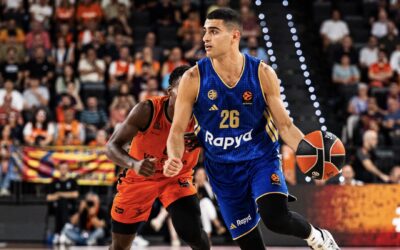
Elijah Bryant was Hapoel Tel Aviv’s barometer this season. On the days he wasn’t there or simply wasn’t good, Hapoel lost in bunches. On most other days, together with Oturu, he was the beating heart of Itoudis’ extremely straightforward offense. Thanks to his quality as a passer, shooter and one-on-one scorer, combined with his ability to maximize his size advantage, Hapoel reached the top six. Bryant, who finished with the third-highest PIR average in Europe (20.6), was one level above Oturu and two levels above everyone else on the roster.
Disappointment of the Season
According to conservative estimates, Vasilije Micić’s salary could buy you two Elijah Bryants. Sure, why settle for either/or when you can have both? But seriously: Micić returned from Charlotte to become MVP, yet he caused quite a bit of damage on the court, and the enormous credit he received across the organization often looked more like a burden than an asset. In the end, in every area where the Serbian contributed to the team, you could argue there was another Hapoel player who did it better. Disappointing.
Breakout Player of the Season
The player who narrowly beat Tai Odiase on points was Kessler Edwards. The American arrived from the G-League with zero expectations and showed he possessed something the roster lacked: venom, grit, fire, you name it. Edwards, who mostly received scraps from Itoudis, was the only “rabbit out of the hat” who somehow managed to challenge Real Madrid during the series, with aggressive defense and defensive rebounding (!). He came out of nowhere and showed he might actually be the missing piece at power forward.
The Real Missing Piece
At the beginning of last week, I attended a match at Turf Moor, Burnley’s home stadium in the English Premier League. Burnley, already relegated a month earlier, hosted a strong Aston Villa side fighting for a Champions League spot and standing on the verge of a European final. As expected from a relegated team, Burnley’s squad was vastly inferior to Villa’s. I was stunned when they scored first and even more stunned when they clawed back late in the game for a dramatic and entertaining 2–2 draw under brilliant sunshine. I believe they managed it because the crowd stood behind them with passion, believed in their football, and helped their players run faster and push harder in pursuit of victory.
Hapoel Tel Aviv won this year for the club, for the owner and maybe even for the coach but not for the fans. Even if the roster is close to perfect, Hapoel must reconnect with its supporters, no matter how. Because when you play for the fans, 100% becomes 200%. And then, maybe, a playoff appearance turns into a Final Four.

0 Comments