


Twelve EuroBasket games were played on Saturday across Europe, with no fewer than 263 basketball players from various nationalities stepping onto similar hardwood floors. All of them, except one, received fewer minutes than Deni Avdija. He had just 100 seconds of rest during the loss to Poland. Considering that he didn’t drive to the basket even once in the fourth quarter, finished 0/4 from three and didn’t score a single point, it’s hard not to attribute this stat line to that overused word, fatigue.
Israel’s national team is entirely dependent on Avdija. That’s a well-known, natural and even expected fact. As impressive as Roman Sorkin’s performance was in the opening win over Iceland, it was clear that without the 20 points and 9 rebounds from the Portland star, things could have gotten complicated. And last night, when No. 8 was left largely alone in battle and had to serve as a point guard for long stretches, while the Polish defense swarmed and focused solely on him he simply ran out of gas.
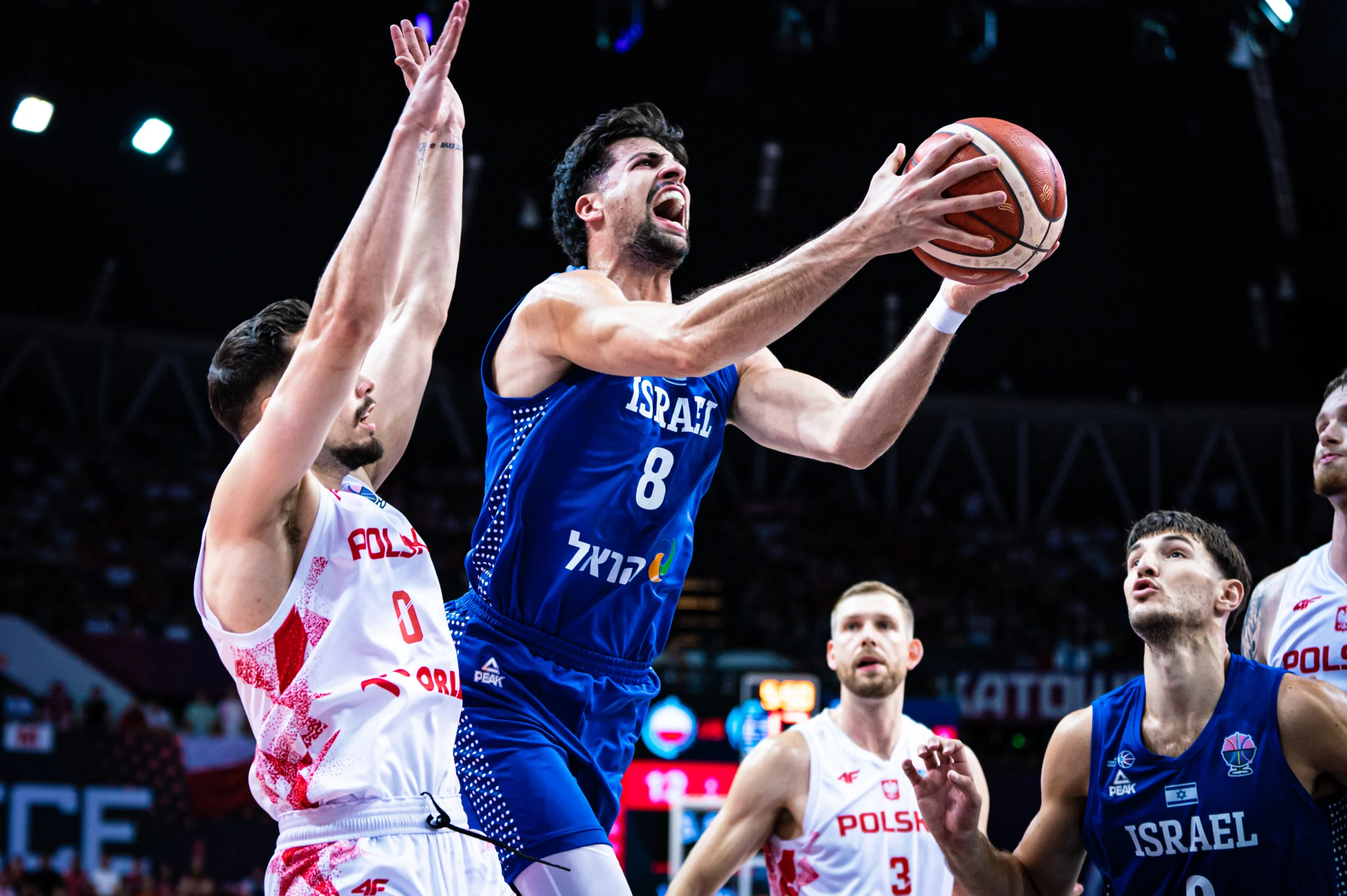
Deni Avdija – Photo credit: FIBA
It was a frustrating loss. A close one. A narrow one. Not particularly high-quality basketball. A loss that, in hindsight, could be marked as the one small thing that cost Israel the campaign—the straw that broke the camel’s back That’s how it goes. We can talk about the referees, the crowd and Jordan Loyd, but bottom line: it came down to a few millimeters that separated a heroic game-winning shot from one that bounced off the rim and ended in collective disappointment.
Israel’s weaknesses were visible during the preparation period, noticeable even in the win over the not-so-lovable Icelanders and became real problems against a stronger and much more aggressive opponent. The most critical and central issue is depth. We promised ourselves we wouldn’t mention Tamir Blatt during the tournament (turns out we lied), and everyone is already familiar with the arguments around his absence. The situations involving Ben Saraf and Danny Wolf were out of anyone’s control. But even within the current roster and the way it was formed, several questions need answering.
Only two rounds of games have passed (three in two of the groups), so the stats come with the necessary disclaimer, but Israel’s bench is the shortest so far in EuroBasket 2025. The bottom half of the rotation, from the seventh to the twelfth man has received a total of 33.4 minutes from coach Ariel Beit Halachmi. Iceland’s bench has slightly more (33.7), Georgia 38.3 (even though Aleksandar Džikić only used ten players), Montenegro 39.5 and Slovenia 39.9. The list goes up from there, all the way to Greece, where the six least-used players average 82.6 minutes per night. Israel, as mentioned, is last among all 24 teams in the tournament.

Yam Madar – Photo credit: FIBA
After the collapse that occurred whenever ABH subbed out his starting five for a breather against Iceland and brought in the bench players, he really tried to avoid weak and unbalanced lineups. It didn’t really work. Yam Madar, due to a lingering and much-discussed injury and a less-than-ideal preparation period, played 31 minutes and didn’t remotely resemble the player he truly is. He and the team as a whole are paying the price for his lack of fitness. He can’t rest, even when struggling or in foul trouble, because there’s simply no one to replace him. And the truth is, it didn’t have to look like this (ahem, Blatt mentioned again, sorry. Ahem ahem, Roi Huber is also missing).
Anyone who expected Bar Timor to take over the point guard role for extended stretches probably hasn’t watched him much at Hapoel Tel Aviv. And anyone who hoped Eitan Burg could fill that role should at least be given the chance to play a few minutes to try. And if the plan from the beginning was to rely on Avdija to fill that critical role too, then his rest minutes should have been better managed.
Coach ABH’s total loyalty to his main five cracked after the team scored just 26 points in the first half. He made a conceptual shift not the usual taller lineup with Yovel Zoosman as the second guard, but instead pairing Kadeen Carrington with Madar. It wasn’t bad and helped spark a comeback. Despite missing wide-open shots, the naturalized guard, lacking in confidence (more on him later in the week), managed to contribute something. That’s encouraging. A bit. Maybe.

Roman Sorkin – Photo credit: FIBA
As for Sorkin, like Avdija, you can grant him the benefit of the doubt due to exhaustion. And again, it’s not surprising. It’s hard to replicate peak performances with such short turnaround times. For example, Lior Eliyahu, who was mentioned here two days ago as the last Israeli to score 30 points in a EuroBasket game (2009), dropped to 12 points in the following game.
But it’s more than that. Sorkin’s big leap in his Maccabi Tel Aviv career came after he was moved to the power forward position. As a center, he struggles against opponents with size, mass and toughness, like the ones that were waiting in the Polish paint. So we’ve already addressed the 9 points and accepted them. But the truly stunning stat? He played 32:36 minutes and grabbed just one rebound. At the end of the day, the most crucial defensive rebound of the game was left to Loyd, who missed from long range and crashed the glass, only to secure what turned out to be the game-winning put back.

Jordan Loyd – Photo credit: FIBA
After all the breakdowns and deep dives, Avdija and Sorkin are the alpha males of this team. And it may well be that without top-level performances from both of them, this team doesn’t really belong at this level. Looking ahead, there needs to be a plan for how to get the best out of them.
Some problems can’t be solved with this current roster. But within these limits, there are possible adjustments like shifting Sorkin back to the power forward spot next to Itay Segev, or using Zoosman as a playmaking guard and giving Burg minutes to reduce reliance on Madar and avoid overworking Avdija.
The answers will come at some point, but not necessarily tonight.
0 Comments